Find Out More Info About Stairs Sanding And Refinishing
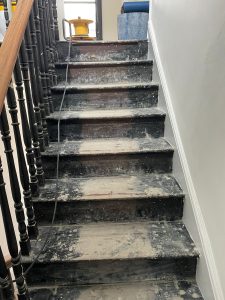
The carpets have been taken up and the real wood that was covered for the past 50 years is finally seeing the light again. But there is a big shock because the real wood is hardly visible and the steps and the risers are covered in about 1 cm of paint, sealers, varnishes, oils, stains, glues and God knows what else. This is usually the moment when most people give up on the idea of restoring the stairs and instead they get carpets. But there are some that can see the potential and they can really visualise how the house will look much cosier and much more elegant if the steps and the risers are restored instead of having them covered up again.
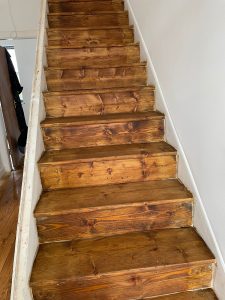
Why Would Someone Apply So Many Coats Of Sealers On The Top Of Each Other?
Well, while your home might be new to you, the staircase is as old as the house itself. In most cases. If the house was built in the early 1900s, then the layer that covers the staircase can be easily identified. Some houses had a lot of woodworms during the industrial revolution. To prevent the wood from being consumed by those little insects most house owners were applying different types of treatments and poisons all over the stairs. Then during the mid 50s, as the solvent paints were getting better, most fashionable households were painting their steps and risers with a thick layer of paint. Usually lead based floor paint. Then in the 70s the carpeted floors were in big demand. To keep up with the new trends and to modernise your home, you had to have your stairs covered with some kind of carpet. The carpet was usually glued to the staircase and that explains all the dry glue found on the steps and risers. So layers over layers of glues, adhesives, sealers, poisons, paints, oils, waxes etc.
Can These Steps Even Be Restored?
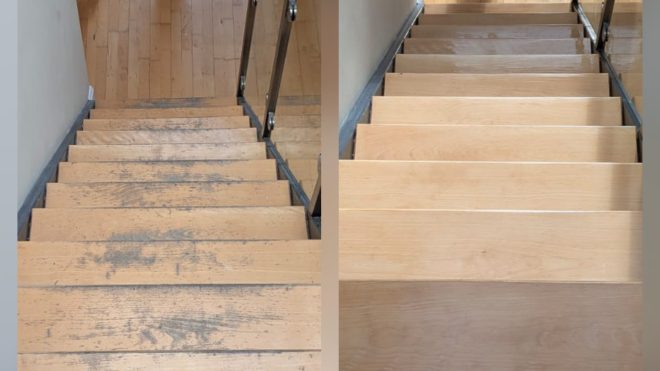
Of course. Your staircase can be fully restored and all that residue can be fully removed but it will take a good bit of time and it will cost a fair bit. There are a number of ways to remove all the waste and the final process will be decided after an initial assessment. Some stairs will be sanded with highly aggressive sanding discs, starting from grit 24 and going up to grit 80-100. In other cases, we are likely to use heat guns or paint removers if the staircase is absolutely covered in paint and the normal sander fails to provide decent results. The final results will vary from job to job based on the initial condition. The main issue with old staircases is the reactions that can happen between the final sealers and whatever chemicals were used to treat the stairs over time.
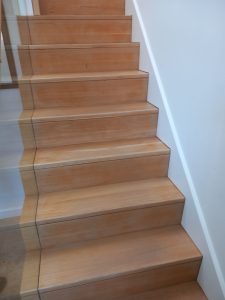
The Most Common Issues That Are Possible During The Renovation
Floor Sanding Dublin is one of the most well established floor sanding contractors in Ireland and after nearly 20 years of doing the same thing over and over, we still have to deal with reactions that are totally new to us. Every set of stairs has its own issues and its own great features. While 90% of the stairs sanding and refinishing projects are likely to go very smoothly, some end up being a nightmare.
-
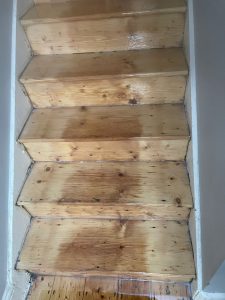
Two Tone Stairs | Some old stairs that had a carpet runner in the middle and the sides were painted with some old solvent based floor paint, are likely to end up with a two tone colour pattern. The side, where the old paint has penetrated deep inside the wood, the wood surface will end up being a slight bit darker than the middle area. Some people just love it that way while others hate it. The issue can be easily resolved by staining the surface with a darkish type of wood stain that will equalise the colours.
-
Wood Worm Damage | Some stairs were really affected by the wood worms and the holes created by it can be really visible after the paint is removed. This is mostly a visual issue than a structural one. The paint that was covering the woodworm damage was unlikely holding the stairs together. While the holes caused by the worms can give the impression of serious damage, in most cases it is not. Again, some people think that the woodworm damage actually gives the staircase some character.
-
Discolorations Under The Lacquer | Some staircases that were really impregnated with poison during the woodworm infestation of the 70s, can end up not absorbing the lacquer evenly. Floor Sanding Dublin has dealt with hundreds of projects where the wood looked impeccable after the initial sanding but the staircase has refused to absorb the lacquer or green|blue patches start appearing under the lacquer as it dried up. There is really no way for anyone to know when that will happen. In some other cases, the green|blue patches appeared 1 month later after the initial lacquering. In those cases, the staircase has to be re-sanded, stained and then sealed with a two pack water based lacquer or a floor wax.
-
Rotten Wood | Another major issue can be rotten wood. Years of washing, bleaching, traffic, etc, have damaged the staircase. While the wood might still hold enough to be safe, it might be making a lot of noise and squeaks. If there is easy access from under it, then there is no problem. The issues start arising when there is an issue under the step but there is no access from below because there is a bathroom ceiling or something blocking the access. If the step itself is affected, it has to be changed because it could just break down at any time. If the risers are affected, the issue is mostly visual because the risers are not holding anything and are not exposed to any intense pressure.
What Types Of Finishes Are The Most Popular?
Well, your imagination is the limit. There are a multitude of finishes and options. The finish can be affected by the condition of the staircase itself, the house design, the colour matching of paints or furniture and by whatever mad ideas the house owner has. We can sand up the staircase and lacquer it with a matt, semi gloss or gloss finish, we can use clear or coloured hardwax oils, we can stain your staircase in over 50 different colours, we can also paint the full staircase if you are planning to use a runner or we can paint the riser and stain the steps in whatever colour you might require.
-
Sanding And Varnishing | The staircase will be sanded in full and then the surface will be either primed with a clear or a coloured primer and then it will be sealed with 2-3 coats of water based floor lacquer. We can use a matt, semi gloss or a gloss floor lacquer. This is the most popular way of sanding and sealing a staircase. A fully refinished staircase will remain fully protected for about 10 years if it receives the correct maintenance.
-
Sanding, Staining And Varnishing | If the customer is trying to hide imperfections on the wood or is trying to create unique finishes, then the staircase can be fully stained before varnishing. The surface will be impregnated with a wood stain, allowed to dry and then sealed with 3 coats of floor lacquer. Our company works with over 50 colours of wood stain so you will be spoiled for options. A stain has no protective quality, it is just a colour that will penetrate the wood before the lacquer is applied.
-
Sanding And Waxing | Some people are looking for the most natural looking finish and a type of finish that allows natural ventilation. For those people we have a wide range of hardwax oils and floor oils from Chimiver, Bona and Tover. A floor oil is available in a wide range of colours or it can be clear. The floor oils are likely to fully penetrate the wood without creating any sheen or glazing. All oiled surfaces will require regular recoatings and proper care.
-
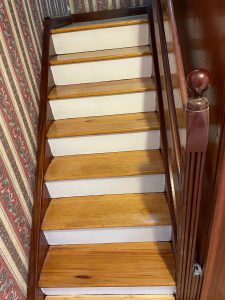
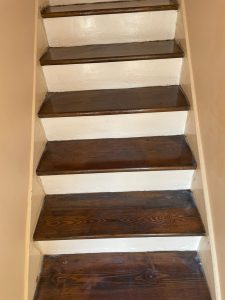
Staining And Painting | Some people ask for a combination of colours to create a more pleasant look. The step to be stained with a darkish colour while the risers to be painted white or some other colour. This mix of colours looks really nice and it creates a much more modern finish. Floor Sanding Dublin will be using an antislip floor lacquer and a very flexible and durable water based floor paint.
-
Full Painting | Some people do not like the way the real wood looks and they ask us to paint the steps and the risers the same colours or different colours and then they just fit a runner right in the middle of the stair. This option is highly recommended when the wood is in a very poor state and it requires a lot of filling and repairs.
As you can see, there are a lot of options to suit all preferences and all budgets. If you are looking for a professional Floor Sanding Company to deal with your stairs sanding and refinishing project, just call Floor Sanding Dublin today and have us drop by and assess your project. We will have a look at your stairs and we will recommend the most cost effective solution. Your idea might be doable or it might not. The price for a full set of stairs can vary depending on the type of stairs, the condition and the finish required. Book a free assessment with us and we will have your price done within 24 hours!
Floor Sanding Dublin uses only the best wood care products. We will sand your stairs with Lagler floor sanding technology and we will seal your stairs with water based floor finishes and waxes from Chimiver and Tover.