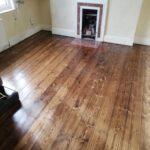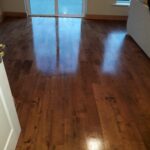
Old Floor Sanding and Restoration
An old timber floor can look tired for all sorts of reasons. The finish has dulled. There are dark marks beside the fireplace, pale patches where rugs once sat, dents beneath chair legs and a procession of nail heads that no modern flooring catalogue would volunteer for.
The obvious renovation instinct is to make all of that disappear.
Sometimes that is exactly what the floor needs. A dangerous splinter, rotten board, loose fixing or failed coating is not “character”. It is a defect. But old timber also carries information in its surface.
Wear patterns, old repairs, tool marks and softened board edges all leave clues about how a room has lived. Sand too deeply and those clues disappear. Yes, the floor gets flatter, paler and tidier. It also gets newer. And you can’t undo that.
That makes floor sanding in an older home less about chasing perfection. Here you’re deciding what deserves to survive.
The Heritage Council estimates that around 175,000 buildings constructed before 1919 are still standing. Thousands more date from the interwar period. Not every one contains a rare or important floor, of course. But enough old fabric survives in ordinary houses that “make it look new” is sometimes the wrong approach.
Risk of Erasing History
A floorboard is easy to underestimate because it spends its life being stood on. Yet in an older building, timber can be part of the historical record in much the same way as old plaster, sash windows or original joinery.
Ireland’s Architectural Heritage Protection Guidelines describe traditional materials as carrying irreplaceable evidence of how a building was made. It specifically points to tool marks on timber and the patina acquired through age, and warns that unnecessary replacement can seriously reduce the authenticity of a historic structure.
That idea applies neatly to floors. A shallow hollow where generations walked through a doorway may be harmless wear. Slightly rounded edges can show where boards were scrubbed for decades. Old square nails or pegs can reveal construction methods that disappeared long ago. A patch using a different but equally old timber might mark a repair carried out before anyone alive today was born.
Patina is not the same as grime
It’s easy for “leave the character” to become an excuse for doing very little.
Dirt is removable contamination. Grease, wax build-up, flaking finish, paint splashes and deeply ingrained deposits can obscure the wood rather than enrich it. Active mould, damp staining or decay needs investigation. A rough edge that catches socks does not become culturally significant because it is eighty years old.
Patina is different. It is the surface change that comes with age and use: subtle colour development, softened texture, minor wear and marks that have become part of the material rather than sitting on top of it.
The judgement lies in cleaning and repairing the floor without automatically stripping away every sign that time passed.
Sanding is an irreversible treatment
Floor sanding removes the coating and a small amount of the wood beneath it. On a modern solid floor with plenty of thickness, that sacrifice is usually part of normal refinishing. On an old board, particularly one that has already been sanded more than once, the stakes are higher.
A typical sanding removes less than about 1/32 inch of wood, roughly 0.8 mm, although heavier correction can remove more. That sounds tiny until you remember that the material never comes back.
Old floors may also be less uniform than modern ones. One board may sit slightly proud, so it loses more timber as the machine flattens the room. The perimeter may already have been heavily edged during an earlier restoration. Boards near a fireplace, doorway or old repair can be thinner than the rest.
Aggressive floor sanding can therefore erase more than scratches. It can remove old saw or plane marks, soften historic profiles, expose fixing heads, weaken thin boards and make later repairs harder to disguise.
Some defects should absolutely disappear
Conservation does not mean preserving hazards.
A floor that moves underfoot, presents sharp splinters or has boards weakened by active decay needs intervention. The same applies to proud nails and screws that can damage sanding equipment or catch a foot, unsupported broken board ends, unstable patches, severe cupping caused by an unresolved moisture problem and boards that are no longer structurally sound.
A good restoration is allowed to improve the floor. The question is how much material and evidence need to be lost in the process.
- Loose or rocking boards: Fix the cause and secure the timber before any surface work. Movement is not patina.
- Rot or active moisture: Deal with the source first. Sanding a damp or decaying board only produces a cleaner version of the same problem.
- Sharp splinters and broken edges: Repair, splice or locally smooth them so the floor can be used safely.
- Severely weakened timber: Retain what is sound, but replace or strengthen sections that can no longer do their job.
Moisture outranks appearance
For traditional Irish houses, the subfloor matters as much as the board surface. SEAI on traditional buildings says suspended timber floors should be investigated carefully before lifting or altering them, and stresses the importance of maintaining subfloor ventilation to control excess moisture.
If boards are cupped, stained, soft at the ends or decaying near a wall, find out why before reaching for an abrasive. A beautiful finish on timber that is still taking up moisture is a short-lived achievement.
The imperfections worth thinking twice about
Once the floor is safe, dry and stable, the harder decisions begin. These are the marks that often sit between defect and history.
Dents and shallow wear
A dent that does not splinter, trap dirt or create a trip point may not need to disappear. Removing it completely can require far more sanding than the surrounding floor needs. On a thick modern board that may be acceptable. On an old wide pine board, it can mean sacrificing a surprising amount of original surface to correct one small mark.
A shallower restoration can leave the floor visibly improved while allowing the deepest wear to remain faintly readable.
Old nail holes and fixing patterns
Historic floors were fixed in different ways. Face nails, pegs and later repairs can form part of that construction story. Empty holes that collect dirt may need filling, and loose fixings need attention, but a row of stable old nail heads does not necessarily need to be disguised until the floor looks factory-made.
The less convincing approach is to fill every mark with a perfectly colour-matched compound and then sand the boards until the repair becomes visually silent. Sometimes the slight trace of the fixing is exactly what makes the floor look like it belongs in the house.
Colour variation
Old timber rarely ages evenly. Sunlight, rugs, previous finishes, species variation, heartwood, sapwood and later replacement boards can create different tones across the room.
A full sand may even some of that contrast by revealing fresher wood, but it will not make different boards genetically identical. Chasing colour differences with increasingly aggressive sanding is usually a poor trade. You lose thickness and the floor still contains different timber.
A coherent finish matters more than absolute uniformity.
Old repairs
A well-executed repair from decades ago can now be part of the floor’s story. If it is stable, compatible and not visually jarring, there is no automatic reason to remove it merely because the timber does not match perfectly.
Repairs should generally avoid false ageing or deliberate disguise. A good repair can be visually quiet while remaining readable on closer inspection.
That is a useful standard for floorboards too. Match species, width, thickness and general tone where possible. Do not feel obliged to counterfeit a century of wear in the workshop before the new piece is allowed into the room.
Not every old floor is a museum floor
There is a risk of overcorrecting in the other direction and treating every old pine board as sacred.
A floor can be old without being unusually significant. Some rooms have already lost most of their early fabric. Others contain boards installed during a relatively recent alteration. A heavily varnished 1970s replacement floor in a Georgian house is old enough to look tired but may not carry the same heritage value as wide early boards with original fixings and tool marks.
It’s less of “How old is it?” and more of “What is this floor, how much survives, and what makes it interesting?”
Start with the basics. Note the width and length of the boards. Look at the timber species and how the joints were made.
Then check the details.Are there hand-worked surfaces? Old pegs? Square nails? Historic patches or decorative borders?
Look at how the floor meets the skirting boards and thresholds too.
These clues can tell you a lot about the floor’s age and construction. They can also reveal whether it was meant to be seen or hidden beneath another covering.
If those features are unusual, the case for conservative treatment becomes stronger. If the surface is already a heavily altered later replacement, a more conventional sanding and refinishing job may be perfectly reasonable.
Protected structures need another check
In Ireland, legal status factors in.
For a protected structure, protection generally extends to the interior as well as the exterior. Works which materially affect the character of a protected structure or an element contributing to its special interest may require planning permission. Owners can request a Section 57 Declaration from the local authority to clarify which works would or would not materially affect that character.
That does not mean every light clean or maintenance treatment requires a planning application. It does mean you should not assume an original floor is ordinary interior decoration just because it is under your feet.
If the house is protected, or you suspect the floor is unusually important, speak to the local Architectural Conservation Officer or an appropriately experienced conservation professional before commissioning aggressive work.
The National Built Heritage Service continues to support owners through the Conservation Advice Scheme for Traditional Houses, specifically encouraging refurbishment that keeps historic fabric and character intact while returning older homes to practical use.
When floor sanding is still the right choice
A conservation-minded approach does not ban sanding. It changes the threshold for using it.
Sanding may be justified where a later coating is badly failed, the surface is rough enough to be impractical, widespread staining cannot be managed another way, previous repairs need gentle blending, or the floor is structurally sound but visually exhausted after decades of incompatible finishes.
The aim should be the minimum cut that solves the actual problem.
That means testing first. A small inconspicuous area can reveal how much finish is present, whether the underlying wood is intact and whether the character you are hoping to preserve survives beneath the coating. It can also show whether a chemical or mechanical stripping method is likely to do more harm than good.
Light restoration and deep correction
A light restoration may remove failing finish, refine a rough surface and prepare the timber for a new protective coating while allowing deeper dents, old tool marks and some colour variation to remain.
Deep correction tries to flatten every undulation, chase out every stain and remove every mark. That approach can be suitable for a relatively modern floor with plenty of timber and no heritage significance. On an old floor, it should have a specific reason behind it.
The finish can erase character too
Sanding is only half the visual decision. What goes back on the floor can change its character just as dramatically.
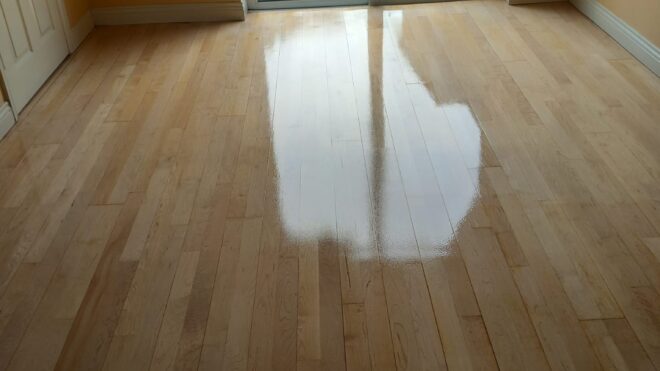
A very high-build glossy coating can make an uneven old floor look strangely plastic, especially where the room originally had a softer, lower-sheen surface. At the other extreme, leaving bare timber unprotected in a hardworking hallway may be impractical.
Modern varnishes can look out of place on historic boards. Traditional maintenance approaches include buffing and waxing polished boards.
That does not mean wax is automatically right for every old floor. Modern oils, waterborne lacquers and other systems can all be appropriate depending on the use of the room, the existing surface and the level of maintenance the owner is willing to accept. The useful principle is visual compatibility. Choose a finish that protects the floor without making it look as though the timber was installed last Thursday.
Low sheen often helps because it allows texture and age variation to remain visible without turning every small dip into a reflected highlight.
Repair versus replacement
One rotten board can start a chain reaction in an over-restored room. The damaged piece is replaced. The replacement looks newer. Three neighbouring boards are then replaced so the patch looks more even. The colour is still different, so the whole floor is heavily sanded. A local repair has quietly become a room-wide loss of original material.
That is exactly the kind of escalation conservation practice tries to avoid.
Good conservation should repair rather than replace where repair is reasonably possible. Minimum intervention, fixing what is wrong without setting out to do too much.
For floors, that can mean repairing only the damaged end of a board. A weak section may be strengthened from below. Lifted boards can sometimes be returned to their original positions. If replacement is unavoidable, reclaimed timber of a similar species and size may be the best match.
Before approving a full restoration, focus on three categories.
- Fix: Anything unsafe, unstable, decayed, actively damp or structurally unsound belongs here.
- Improve: Failed coating, ingrained contamination, rough fibres, ugly later filler and badly executed modern repairs may justify careful surface work.
- Keep: Stable old fixings, minor dents, gentle wear, colour variation, honest historic patches and tool marks can stay if they do not compromise use or safety.
The floor can then be cleaned, repaired and sanded only as far as the “improve” category requires.
How perfect should the finished floor be?
The boards should be stable. The floor should be safe to walk on and practical to clean. Active moisture and decay should be resolved. The finish should protect the timber. Repairs should be competent. Nothing should feel neglected simply because the building is old.
Beyond that, uniformity is a design choice..
A century-old floor does not have to be completely flat, identical in colour and free of every nail mark to count as restored. In fact, making it that uniform may require removing the very surface that proves it survived a century in the first place.