SAICOS Ecoline MultiTop Water-Based Lacquer for Homeowners and Contractors
SAICOS Ecoline MultiTop is a one-component polyurethane lacquer developed for normal and high wear on wood and bamboo floors, parquet, multi-layer flooring and interior timber surfaces. The base lacquer can be used on its own for suitable residential work, while the wider system allows a contractor to add a hardener or use a compatible primer when the floor presents different demands.
Let’s look at how SAICOS Ecoline MultiTop fits into a properly planned timber floor project.
The Lacquer That Delivers
By being ‘water-based’, the lacquer uses water as the main carrier for the liquid coating. During application, the product spreads across the prepared timber. As water and other volatile components leave the film, the polyurethane binder forms a continuous protective layer on the surface.
The finished coating is not water. Once the lacquer has dried and cured, it is a solid film designed to resist normal use. So water-based does not mean the cured floor can be soaked, cleaned with unlimited water or treated as though the coating can be rinsed away.
For a homeowner, you can use water clean-up for application tools, and expect typical odour while the liquid product is being used and a shorter working programme than many older solvent-rich systems. For a contractor, it means that temperature, humidity, application weight and the time between coats must be controlled carefully. Water needs a suitable route out of the film, so poor ventilation, low temperature or high humidity can slow the process.
The base product is a one-component lacquer, often shortened to 1K. You open the container, prepare the product according to the current instructions and apply it without adding a separate reactive hardener. When Ecoline Hardener 2K is added, the system becomes a two-component coating with a limited working time and different handling requirements.
Water-Based Does Not Mean Chemical-Free
SAICOS Ecoline MultiTop contains a polyurethane binder and other ingredients needed to form and preserve the coating. The product also has a maximum volatile organic compound content of 140 grams per litre. In Ireland, decorative paint controls sit within the European rules for VOC emissions from paints and varnishes. The water-borne limit for one-pack performance coatings in category A/i has been 140 grams per litre since 2010.
Water Clean-Up
Application tools can be cleaned with water while the product is still fresh. That makes end-of-day tool care more straightforward than systems that require a dedicated solvent cleaner. It can also simplify site organisation because the contractor does not need to use a solvent solely for cleaning the recommended roller.
Prompt cleaning still matters. Once the lacquer has formed a film, water will not return it to its liquid state. The roller, filter and other equipment should be cleaned at the time set out in the working method rather than left until the next day.
Wastewater should not be poured onto soil, into surface drains or into an uncontrolled waste route. The product and any hardener should be handled in line with the current safety data sheet and local waste requirements. Water clean-up describes the cleaning medium, not a licence to dispose of residue carelessly.
Odour During Work and After Drying
The liquid product has a typical odour and is odourless after drying. Therefore, a freshly coated room may still smell during the working period, even though the lacquer is water-based.
Plan ventilation and access before work starts. Keep the coating area separate from occupied rooms where possible, stop dust from moving through open doorways and follow the safety information for the exact system being applied. The Hardener 2K requires outdoor use or a well-ventilated area and calls for suitable protective gloves and eye or face protection.
You should also separate odour from cure. A floor that no longer smells strongly may still be within its early curing period. Furniture, rugs and heavy use should follow the approved return-to-service schedule rather than your sense of smell.
Quick Product Overview
SAICOS Ecoline MultiTop can be applied to solid timber flooring, parquet and multi-layer flooring. The standard system carries an R9 slip-resistance classification and DIBt approval number Z-157.10-162.
There are three 4.55-litre options in Ireland: Ultra Matt, Silk Matt and Satin. Those are variations of the visual sheen. The coating system and application decision still need to account for the timber, wear level, primer and any supplement.
The application quantity is 100 to 120 grams per square metre for each coat. At the hardener-system ratio, 0.45 litre of Hardener 2K is paired with 4.55 litres of MultiTop, giving 5 litres of mixed material. That volume covers about 45 square metres for one coat, with actual coverage changing according to wood species and surface structure.
For technical reference, the base lacquer has a density of 1.01 to 1.06 grams per cubic centimetre, a viscosity of 25 to 32 seconds in a 4-millimetre cup under DIN 53211 and a flashpoint above 100°C under DIN 53213. Unopened base product has a minimum storage life of 12 months and must be transported and stored frost-free above 5°C.
What Homeowners Should Know Before Work Begins
A water-based floor finish can shorten disruption, but you still need a realistic household plan. The coating area must be cleared, sanded, cleaned and kept free from traffic while the coats dry. Your contractor also needs room to manage dust, rollers, containers and safe access without people crossing the wet floor.
Start by identifying the route through your home. If the hall is being coated, can you enter through another door? If stairs are included, can bedrooms be reached without using them? If an open-plan kitchen and living area is being treated, where will meals be prepared while the floor is unavailable?
Planning Around Drying and Return to Use
Dry to recoat, slightly walkable, light traffic and fully cured are different stages. Dry to recoat means the next layer can be applied under the stated conditions. Slightly walkable means limited movement may be possible for the coating process. Light traffic allows careful use. Full cure means the coating has reached the published level for normal service.
The product has a drying time of 3 hours, light traffic after 8 hours and full cure after 3 days at 20°C and 60% relative humidity. Expect 3 to 4 hours between the first and second coats, and the second coat will be slightly walkable after 3 to 4 hours. It uses approximately 8 hours after the third coat for complete curing and full resistance.
Temperature and humidity can move those timings. A room at the lower end of the recommended temperature range with high humidity will not behave like a room at 20°C and 60% relative humidity. Do not arrange furniture delivery, cleaning or another trade solely around the shortest figure.
Keep rugs, protective sheeting and heavy furniture off the coating until the approved cure point. Covering a young finish too early can interfere with moisture release or mark the surface. Likewise, dragging a sofa across a floor that is open to light foot traffic can create concentrated loads long before normal use is appropriate.
Managing Ventilation and Room Access
Ventilation should remove moisture and vapour without carrying dust across the wet coating. That balance is important. Throwing every window open on a windy day can introduce grit, pollen or building dust. Keeping the room tightly sealed can slow drying and concentrate odour.
Agree the ventilation method with the contractor before application. Keep children and pets away from the work zone, close internal doors where practical and stop other trades from cutting timber, sanding filler or creating dust nearby. Even a small amount of airborne debris can settle into a fresh coat.
Room temperature should also remain stable. Portable heaters pointed at one section of floor can create uneven drying. A well-controlled room between 15°C and 25°C is the stated application range, so local hot spots and cold corners should be avoided.
What the Finished Floor Still Needs From You
Water-based does not mean wet-cleaning tolerant. A timber floor should be swept, vacuumed or dusted regularly so grit does not act like abrasive paper under shoes and chair legs. Damp mopping should use a well-wrung mop and the compatible care product rather than a pool of water.
Wipe spills promptly, fit clean entrance mats and use suitable pads under movable furniture. These small steps reduce concentrated wear at doors, dining chairs and desk areas. They also help the coating keep an even appearance between maintenance treatments.
The maintenance programme includes a refresher treatment every 3 to 6 months. The actual interval will depend on footfall, cleaning frequency and visible condition. A quiet bedroom and a family entrance hall should not be treated as though they receive the same wear.
Questions to Ask Your Contractor
Confirm the final sanding grit, the sheen, the number of coats and whether a supplement is part of the system.
You should also ask which published timing will control access, light traffic, furniture replacement and full use. Confirm how underfloor heating will be managed, how ventilation will be provided and what care products will be required.
Finally, request a trial coating on the original timber. That sample checks colour, sheen and compatibility before the full floor commits you to one finish.
What Contractors Should Plan Before Application
MultiTop is straightforward to apply only when the substrate and site are ready. A water-based lacquer will not correct excessive moisture, old coating residue, inconsistent sanding or dust. The preparation sequence should therefore be written into the job plan before materials are opened.
Assess the Substrate and Moisture
The timber must be dry and clean, with a maximum wood moisture content of 12%. Measure the floor in several representative positions, including areas near external doors, recent repairs and underfloor heating zones. One reading in the centre of the room does not describe the full substrate.
Check for loose boards, movement, contamination, filler failure and previous maintenance products. Silicone, wax, oil residue and household polish can affect wetting or adhesion. Any uncertainty should be resolved through cleaning, sanding and a representative test area.
The species must also be identified. Hardwood, exotic wood and thermally treated wood need an appropriate ground coat within this system. Species with water-soluble components can produce visible bleeding, which requires a separate compatibility decision rather than a change in roller technique.
Remove Old Coatings and Sand Consistently
All remaining lacquer or paint must be removed where the specification calls for coating bare timber. Final sanding should use 120 to 150 grit across the main floor and the edges. The edge sanding must match the field closely because a different scratch pattern can create a visible border after the clear lacquer is applied.
Dust removal should be thorough and dry. Use a suitable vacuum and a clean dry cloth where needed. Wet wiping introduces moisture and may raise the grain immediately before coating. It can also move fine dust into joints rather than removing it.
Inspect in low-angle light after vacuuming. Sanding swirls, edge marks and filler smears are easier to correct before the first coat than after a clear film has made them more visible.
Control Temperature Humidity and Working Conditions
Apply the lacquer between 15°C and 25°C. Record room temperature and relative humidity rather than relying on outdoor weather or a wall thermostat in another room. The floor temperature matters as well, especially over underfloor heating or in an unoccupied property.
High humidity slows water release and can extend drying. High temperature with low humidity can shorten open time and increase the risk of lap marks across a large area. The working plan should match the room size, crew size, roller width and route to the exit.
Stable conditions should continue through drying. Sudden heating, strong draughts and direct hot air can make one area behave differently from another. A uniform environment supports a more consistent film.
Use the Correct Roller and Application Quantity
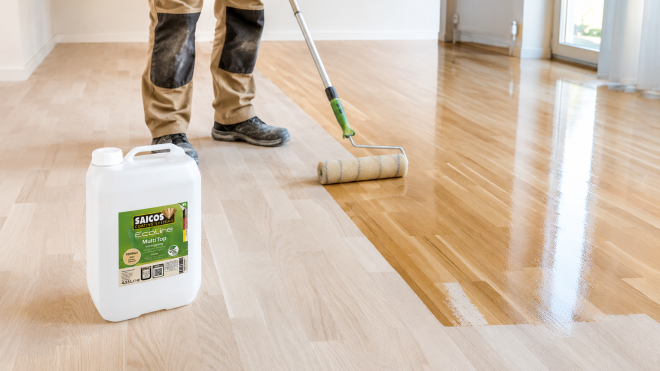
The specified application tool is the SAICOS Aqua Roller. Apply 100 to 120 grams per square metre for each coat. On a 30-square-metre room, that equals about 3.0 to 3.6 kilograms of lacquer per coat before allowing for the container, roller loading and unavoidable working loss.
A coat that is too thin may not level or build the intended film. A coat that is too heavy can extend drying and create an uneven surface. Weighing material before and after a measured section is a practical way to check application rate on site.
Material planning should also account for the full coating build. A 4.55-litre container is not a 45-square-metre complete-floor allowance when two or three coats are required. The 45-square-metre figure relates to 5 litres of mixed 2K material for one coat and varies with the surface.
Plan the Coat Sequence and Intermediate Sanding
The first coat may be a compatible primer or MultiTop with the selected supplement. The second and third coats use MultiTop according to the chosen system. Remember that it’s 3 to 4 hours of drying between early coats under suitable conditions. Limit application to a maximum of two lacquer coats in one day.
Intermediate sanding is set at about 6 hours with 120 to 150 grit, followed by complete dry dust removal. The purpose is to smooth raised grain and provide an even base for the next layer. Sanding too early can clog the abrasive or disturb a film that has not developed enough strength.
The crew should record coat times, room conditions, product batches and any supplements used. These notes give the client a clear handover record and make later maintenance or recoating easier to plan.
Manage Underfloor Heating Correctly
Switch underfloor heating off 36 hours before application and leave it off until 24 hours after the final coat. This timing applies to the supplied MultiTop data and should be checked against the current project sheet before work starts.
The aim is to stop the substrate from becoming a local heat source during application and early drying. A warm floor can reduce working time, alter film flow and create different drying rates across heating zones.
When the heating returns to service, follow the flooring and heating-system guidance for a controlled restart. Avoid an abrupt jump to the highest setting because timber and coating both respond to rapid changes in temperature and moisture.
The One-Component Base and Hardener 2K Option
MultiTop begins as a one-component lacquer. That base format is suitable for many residential surfaces that do not face extreme demands. It avoids a reactive mixing stage and leaves no two-hour pot-life pressure once the container is opened.
Hardener 2K changes the application and the performance route. It creates a two-component water-based system for higher resilience, faster drying under difficult conditions, increased abrasion resistance and increased resistance to chemicals. This option is relevant to busier floors, commercial interiors and projects where high humidity would otherwise slow the coating schedule.
When the Base Lacquer Is Suitable
A living room, bedroom or other domestic area with normal wear can often use the base product without hardener, subject to the timber and full specification. The decision should consider entrance grit, pets, movable furniture, cleaning habits and the time available before the room returns to service.
Using the base does not reduce the need for correct sanding, moisture checks or measured application. It simply means the performance brief does not call for the reactive hardener route.
The hardener is supplied at 0.45 litre for 4.55 litres of MultiTop, a 1:10 ratio. Shake the combined product for 1 minute, allow it to rest for about 5 minutes, shake it again and fit the supplied filter. The mixed lacquer must be used within a 2-hour pot life.
Do not keep a mixed container permanently closed. When Hardener 2K is needed, it must be included in the final two lacquer coats. A pure lacquer build can omit the hardener from the first coat.
When a Primer Is Needed
A clear water-based lacquer interacts with the timber beneath it. Density, extractives, heat treatment, sanding and prior products all affect the coating. Therefore, one method cannot be applied blindly to oak, bamboo, thermally treated ash and exotic hardwood.
The MultiTop system covers solid wood, parquet, multi-layer flooring and bamboo, but the primer route changes with the substrate. A trial coating on the original timber is part of sound specification, not an optional sales sample.
Hardwood, exotic wood and thermally treated wood should be combined with Ecoline Oil Ground Coat or Ecoline Ground Coat Speed. A suitable primer also reduces side bonding, where lacquer joins the edges of adjacent boards and restricts their independent movement.
The primer can influence colour, grain and sheen, so the trial panel must include it. Testing MultiTop directly on an offcut and then applying it over a ground coat on the main floor does not reproduce the approved build.
Wood Bleeding and Trial Coating
Merbau, Jatoba, Afzelia, Robinia and Acacia contain water-soluble components that can move into a water-based coating and appear as spots or discolouration. This is known as wood bleeding. It comes from the substrate rather than dirt settling on top of the lacquer.
Prepare the trial area with the final sanding sequence, primer, sheen and coat build. Allow enough time to assess colour movement, adhesion and appearance. If the sample shows bleeding or an unexpected tone, change the system before the full area is coated.